


Syllabus: GS3/Environment
Context
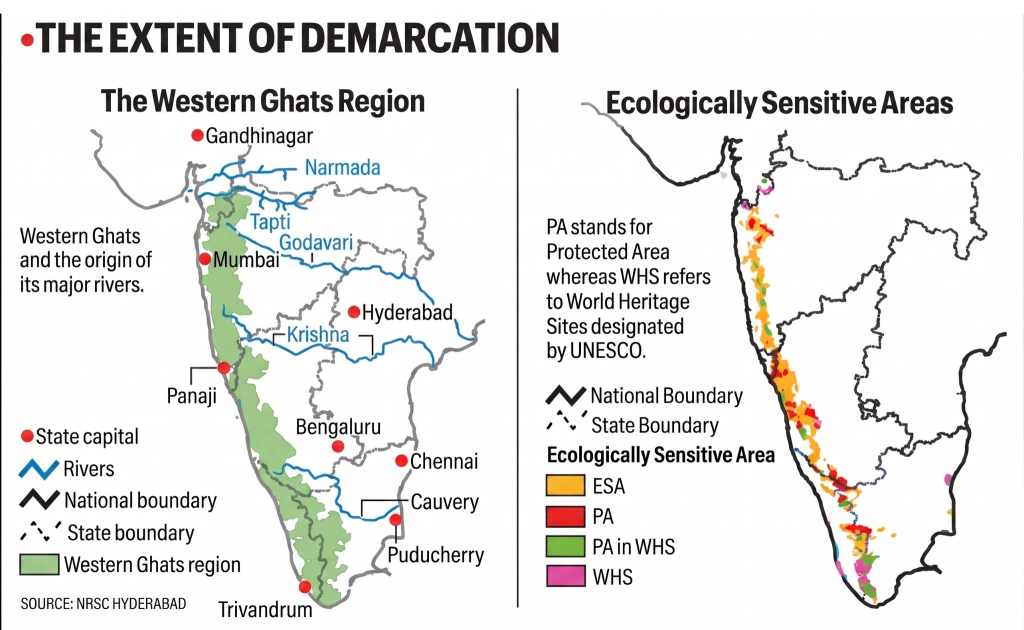
- Centre is finally ready to finalise and notify the demarcation of Ecologically Sensitive Areas (ESA) in the Western Ghats region, and may soon receive stronger legal protection in three Indian states i.e. Gujarat, Goa and Maharashtra.
About Western Ghats Ecologically Sensitive Area (ESA)
- The Western Ghats, stretching over 1,500 km along India’s western coast across six states i.e. Gujarat, Maharashtra, Goa, Karnataka, Kerala, and Tamil Nadu.
- They constitute one of the world’s eight ‘hottest hotspots’ of biological diversity, spread over approximately 1,64,280 sq km.
- It holds vital importance for the regulation of Indian Monsoon, climatic regulation, soil conservation and providing water security to millions of people.
- This area is considered as a UNESCO World Heritage Site due to its unique biological diversity and endemism.
Ecologically Sensitive Area (ESA)
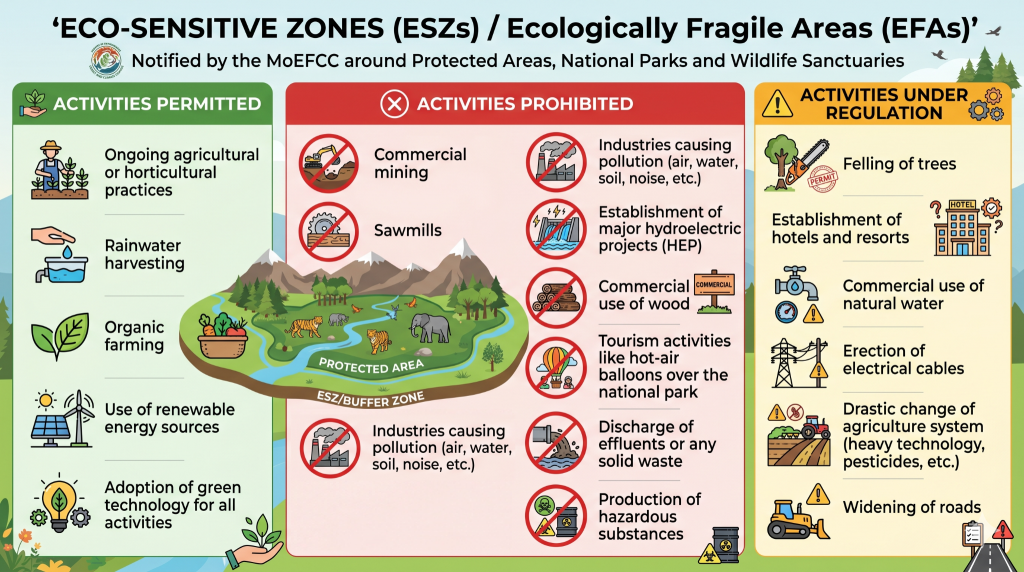
- An ESA means that region declared under Environment (Protection) Act, 1986 for the conservation of ecologically sensitive ecosystems.
- Such areas are notified by MoEFCC considering their biodiversity, environmental sensitivity and ecological significance, and the need for regulating developmental activities.
- Those activities which have adverse impacts on the environment such as mining, quarrying, pollution intensive industries and construction activities are either banned or regulated.
- The objective is to ensure a balance between environmental conservation and sustainable development while safeguarding ecosystem services and local livelihoods.
Other Regions in India Designated ESAs
- Kumbhalgarh Wildlife Sanctuary in Rajasthan (Aravalli Range)
- Kaziranga-Karbi Anglong landscape, Assam
- Gir National Park, Gujarat
- Ranthambore Tiger Reserve, Rajasthan
- Sundarbans, West Bengal
- Great Indian Bustard habitats in Rajasthan and Gujarat
- Bhagirathi Eco-Sensitive Zone, Uttarakhand
- Chilika Lake, Odisha, and Deepor Beel, Assam
Ecological Significance of the Western Ghats
- Biodiversity Hotspot: The region is home to nearly 30% of India’s flora and fauna and exhibits high endemism.
- Several endangered species including Lion-tailed macaque, Nilgiri tahr, Malabar civet, Great Indian hornbill inhabit the Western Ghats.
- Water Security and Climate Regulation: Western ghat acts as a water-divide and serves as a wind barrier, affecting rainfall patterns over peninsular India.
- Major rivers like Godavari, Krishna, Cauvery, Tungabhadra, Periyar originate from the Western Ghats.
- Dense forests help in groundwater recharge, carbon sink, and disaster management.
- Socio-Economic Significance: The Western Ghats sustain millions by agriculture and plantations unlike Himalayas.
- The region is known for export crops like pepper, cardamom, coffee, tea, cinnamon, rubber, and spices.
- The ecosystem supports tourism, hydroelectricity generation, and livelihood.
Evolution of ESA Delineation: Gadgil vs Kasturirangan
- Gadgil Committee (Western Ghats Ecology Expert Panel, 2011): It defined the Western Ghats region as 1,29,037 sq km and proposed declaration of the whole Western Ghats as ESA.
- It suggested a graded regulation regime with strict norms on mining, pollution industries, and mega infrastructure projects and promoted participatory bottom-up approach involving local bodies.
- Kasturirangan Committee (High-Level Working Group, 2013): It adopted a more balanced approach.
- It defined the total Western Ghats landscape as 1,64,280 sq km and recommended designation of approximately 60,000 sq km as ESA.
- It differentiated between Cultural Landscape (60%) and Natural Landscape (40%).
- It suggested ban on mining and quarrying, prohibition on red category polluting industries, restriction on thermal power plants, and regulation of large scale constructions and township projects.
Why Has ESA Notification been delayed?
- State Government Opposition: State governments feel ESA notification might hinder industrialization and infrastructure development, impede plantation agriculture and livelihoods, and limit revenue generation from mining and quarrying activities.
- Disputes over Boundaries: The Centre’s draft notification had proposed 56,825 sq km as ESA.
- States were making demands for exclusions through ground level survey findings.
- Kerala, Karnataka and Maharashtra are demanding huge reductions in the area.
- Challenges in Data Reconciliation: Difference in satellite imageries, village wise data, revenue records, land uses have made consensus difficult.
Recent Developments
- Expert Committee (2022): MoEF&CC has formed an expert committee headed by former Director General of Forests for reevaluation of objections raised by states.
- Some major tasks are reconciliation of village wise data, field verification, and review of proposals for monetary incentives to states.
- Draft Notification (July 2024): It has introduced an important provision like:
- ESA boundaries can now be finalized either state-wise or through combined notification.
- It intends to avoid delays in states where a consensus is possible.
Why is the Protection of Western Ghats Crucial?
- Increasing Ecological Threats: The Ghats are being threatened by deforestation, quarrying and mining, expanding infrastructure, unregulated tourism and climate induced extreme rainfall events.
- Recent landslides in Kerala and Karnataka have underscored the vulnerability of the ecosystem.
- Ecosystem Services: Western Ghats offer valuable ecosystem services including water provisioning, floods moderation, carbon sink, pollination and soil conservation.
- These services not only serve six states but also the whole nation.
- Imperative of Sustainable Development: Protection of the region does not mean exclusion of people.
- Instead, it means promotion of sustainable agriculture, eco-tourism, community involvement, compensation mechanisms and payment for ecosystem services.
Way Forward
- There needs to be a balanced approach to integrate protection and development. Key measures include:
- Boundary delineation of ESA through scientific and participatory consultations.
- Offering financial incentive and compensations to states and communities.
- Devising decentralized environmental governance through Panchayati Raj Institutions.
- Promoting sustainable livelihood and climate resilient agriculture.
- Stringent regulation of mining and polluting industries in ecologically sensitive regions.
Previous article
India’s Emerging Technology Ecosystem
Next article
News In Short 23-06-2026
